A journal on turning inward — not out of loneliness, but out of love.
By Ellie · November 5, 2026

I’ve always worked best alone. If I’m honest, I sometimes prefer doing things on my own.
I work faster alone. I think more clearly alone. There’s a specific type of relief in it. Nobody’s pace to match, no one to perform for.
For years, I’ve assumed that it was something I’d settled into because I had to.
But looking back now, I’m not sure if that’s the truth.
You see I grew up watching my mother do things on her own.
She didn’t seem to need a room full of people to decide or go after something she truly wanted. She just did things. She figured them out. She achieved things and, little by little, built a life that looked like winning to me.
It was something I couldn’t quite put a name to, as a child
All I know is that she’s capable. She could handle things on her own.
I don’t remember anyone teaching me that. There was never a conversation about independence, no grand lesson about becoming a strong woman. I just watched her live.
Children are good at that. We absorb things long before we know we’re absorbing them.
So maybe I didn’t learn to be alone because I had to. Maybe some part of me had already decided that this was what a woman looked like when she knew she could handle her own life.
And then there was the way I grew up.
I was surrounded by cousins, which is the part people get wrong when I tell them.
There was no shortage of family. Nobody left me out; nobody shut the door. The house was full.
It just happened that there was no girl my age in it.
The cousins near my age were boys, and the girls were older or much younger. So there was always a group, and I was always slightly beside it, and nobody had done anything wrong.
It never really bothered me. I was good at being alone.
I had my own world.
I made up scenarios and lived inside them. I had conversations with people who weren’t in the room. An entire world ran behind my face that nobody else could access, and sometimes it was better company than most of what was available.
I wasn’t unhappy.
You don’t experience the arrangement you were born into as a loss — you experience it as how things are.
People thought it was strange. Not unkindly, and not often. They’d remark on it the way you’d remark on any odd little habit, and then the moment would pass, and nobody would think about it again.
I thought about it.
That’s the thing about being called a little odd by people who mean you no harm: there’s nothing to argue with. No cruelty to point at, no injury to name. Just a small fact quietly filed away — that the thing I did most naturally, when left to myself, looked strange from the outside.
So, it was never, I’m lonely.
I wasn’t, particularly.
It was closer to: This is being seen, and it isn’t reading well.
It took me an embarrassingly long time to work out what that meant.
I wasn’t afraid of being alone.
I was afraid of being judged for being alone.
Those are two very different fears.
And I spent most of my life solving for the wrong one.
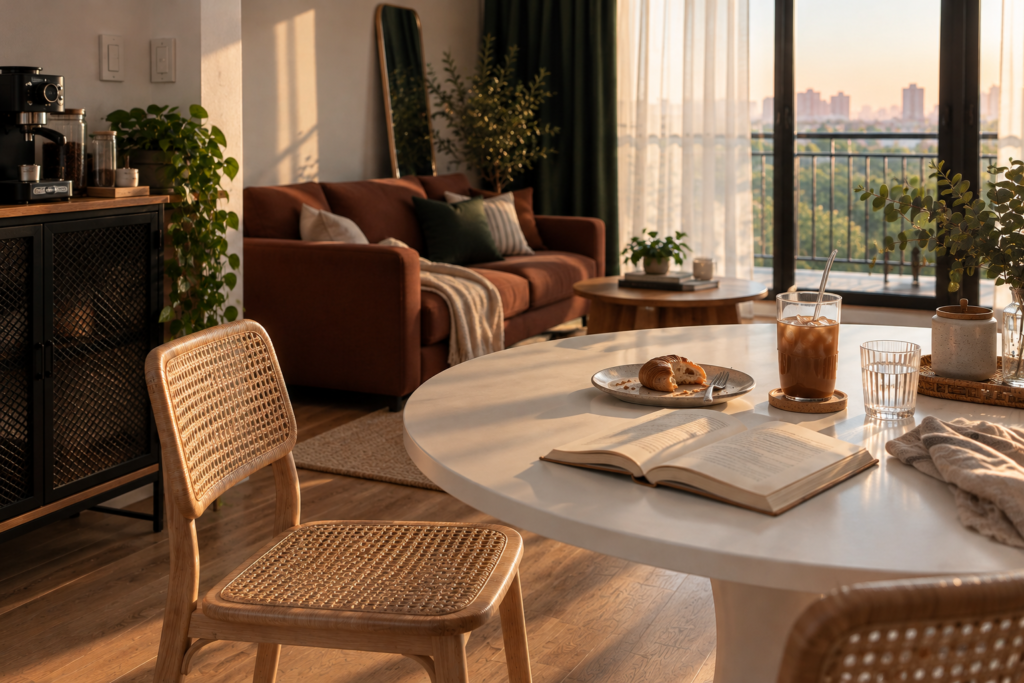
The first time I ate at a restaurant alone, I brought a book as an alibi.
I didn’t read it. I opened it, arranged it beside the plate, and kept my eyes on the page the way you do when the page isn’t the point. What I was really doing was building a small structure around myself so nobody at the other tables would think I’d been stood up.
I wasn’t unhappy to be there. That’s the part I’d have got wrong if you’d asked me then. I liked the meal, I liked the quiet, I’d chosen it. I just couldn’t bear to be seen choosing it.
I ate there again a few months ago. No book. I ordered what I wanted, took my time, and watched the street. Nobody looked at me. Nobody had ever looked at me.
It’s such a small thing. But I sat there afterward thinking about how long it took to get from one version of that meal to the other, and how nobody had been there to see it happen.
That belief followed me into every room afterwards. And it’s why, for a long time, I thought being my own best friend was a consolation prize — something you settled for when nobody had chosen you, and hoped nobody noticed.
I think that’s more common than we admit, partly because of how self-love gets sold.
Half of it is packaged as compensation. Learn to be alone. You are enough on your own. Beautiful sentences, usually arriving right after someone’s left behind. It reads like an anesthetic — something you take because the alternative isn’t available.
The other half gets used as a door closing. You have to love yourself first, said more often than not by someone who has just decided not to show up for you and would like the exit to sound like wisdom.
So, I had two models: self-love as a bandage, or self-love as a brush-off. Neither looked like something you’d choose on a good day.
What I did instead was wait.
I waited for people to notice. To remember. To invite. To check in without being prompted. To love me the way I longed to be loved — gently, consistently, without needing to be reminded that I existed.
And I was good at waiting, because I filled it with work. I remembered everyone’s dates. I sent the messages first. I asked follow-up questions, checked in after the interview, and noticed when someone went quiet. I kept a running ledger in my head of everyone’s difficult weeks.
I told myself it was love, and mostly it was.
But something else was in it.
I was keeping the ledger because I believed it would be read back to me one day — that if I was attentive enough, present enough, someone would notice the pattern and match it.
That is not how any of it works. People aren’t withholding a version of themselves that would appear if you earned it. Mostly, they’re doing what they do, at the depth they do it, and it has almost nothing to do with you.
I spent a long time disappointed by people who behaved exactly as they always had.
I got tired of asking people to hold what they never earned the right to carry.
That’s the sentence, for me. Not a boundary, exactly. Something quieter than that.
Because I used to hand over my interior indiscriminately. Anyone who was kind to me got the whole thing: the fears, the plans, the half-formed ambitions I hadn’t tested yet. I mistook proximity for safety. I thought if someone was close, they would be qualified.
They weren’t. Some were lovely and simply not built for it. Some were interested in the version of me that didn’t have needs. And a few weren’t paying much attention.
Handing something precious to someone who hasn’t earned it isn’t generosity. It’s a gamble. I was losing it regularly and then treating the loss as evidence about my worth rather than evidence about my aim.
So, I stopped. Not out of bitterness — out of accuracy. I got better at knowing who could hold what.
And the person who could hold all of it was me. That wasn’t a downgrade. It had just never occurred to me to check.
Much less cinematic than the posts about it, is the honest answer.
It’s keeping small promises. If I say I’ll stop working at a certain hour, I stop. If I say I’m taking the day, I take it — I don’t quietly refill it with something else that also counts as work. Self-trust isn’t built by dramatic gestures. It’s built the way trust with anyone else is built: by a long series of ordinary times, you did what you said you’d do.
It’s keeping my own hours without apologizing for them. My days don’t run the way most people do, and for years I treated that as something to explain — the same reflex as the book beside the plate. A particular quiet belongs to the hours when everyone you know is asleep. I used to find it lonely. It’s now part of the day that is most reliably mine.
It’s writing. I’ve never been good at saying how I feel out loud; it comes out flat, or too late, or not at all. On paper, it arrives. Most of what I write is unreadable, and none of it is for anyone, and that’s the point — it’s less a diary than a conversation with the only person guaranteed to still be in the room.
It’s knowing my own moods before they arrive. I can feel the retreat coming a day or two ahead now, the way you can smell rain. I don’t always stop it. But I stopped being ambushed by myself, and that alone changed things.
It’s marking my own progress when nobody claps. Most of what I’m proudest of is invisible to everyone but me — things I stopped doing, reactions I didn’t have, conversations I handled well when the old version of me would have crumpled. Nobody throws a party for that.
And it’s the other half, which is really the same half: I don’t ghost myself anymore.
I used to, constantly. I’d override my own no because saying it out loud felt rude. I’d stay in a conversation that was making me feel small, waiting for it to end, angry at myself afterwards for not leaving. I’d feel something arrive in my chest and immediately open my laptop so I wouldn’t have to sit with it.
I’d notice I was hurt and decide it wasn’t worth mentioning. Notice I was at capacity and say yes anyway, because the discomfort of disappointing someone was louder than the discomfort of disappointing myself.
That’s what it means to abandon yourself, I think. Not a dramatic act. A thousand small moments of choosing someone else’s ease over your own accuracy.
I sit with it now. Not gracefully. But I stay. And I’ve stopped demanding that the tears explain themselves before I’m allowed to have them.
It’s a quiet kind of companionship. No applause. No group photos. No long, dramatic captions on a birthday. Just a woman who wakes up and says, I’ve got you. Let’s try again today.
I want to complicate all of it, because the piece would be dishonest without this part.
Self-sufficiency can become a hiding place.
There’s a version of I’m my own best friend that isn’t peace at all. It’s armor, wearing peace as a costume. It sounds like I don’t need anyone, said with a lift of the chin, and underneath it is someone who got hurt badly enough that need itself started to feel dangerous.
I’ve been in that version. It’s seductive, because it looks identical from the outside and hurts less in the short term. You stop asking, so you stop being disappointed. You handle everything, so nothing can be dropped. You become tremendously impressive and completely unreachable.
The tell is how you feel when someone offers it. If a friend says let me help with that and your first instinct is a flat, immediate no — not because you don’t need it, but because being helped feels like exposure — that isn’t self-sufficiency. That’s a wound that learned to wear a nice outfit.
Being your own best friend doesn’t mean you don’t need people.
It means you no longer abandon yourself waiting for them.
There’s a whole world between those two sentences, and most of the good part of my life is in it.
Some relationships didn’t survive it, and I should say so.
When you stop asking people for scraps, a few of them notice and they don’t like it. Not because they’re villains — because the arrangement worked for them. They had someone endlessly available, who never needed much, who could be relied upon to reach out first and forgive quickly and not make anything difficult.
Then that person stopped, and there wasn’t much underneath.
That was painful in a way I didn’t anticipate. I’d expected to feel free, and mostly I did. But I also grieved, quietly, for a few people I’d loved sincerely who turned out to have loved my usefulness.
The strange part was that there was no event to point to. No betrayal, no argument, nothing I could describe to a third party that would sound like a reason. I simply stopped initiating, and the friendship stopped happening — the way a plant nobody waters stops growing. It turned out I had been the entire weather system.
What’s on the other side is smaller and better. Fewer people. Deeper access. A handful who knows the whole thing and stayed anyway, and whom I no longer perform for.
And I still want closeness. I want warm, deep, and reciprocal love. I want people who remember it without being reminded. I want the group photo and the long birthday caption and someone who notices when I’ve gone quiet.
Becoming my own best friend didn’t make me want any of that less. It meant I stopped negotiating for it from a position of scarcity.
My own company was never a problem. Being watched in it was. That’s the part that has loosened — I can be alone in front of people now without reaching for the book.
This is where an essay like this should be resolved.
It hasn’t, entirely.
Not on ordinary days. Those are fine; those are mine. It’s the big ones. When there’s something significant to plan, and I notice I’m planning it alone, running the whole thing through my own head the way I ran everything through my own head at six. Or a hard stretch — the kind where you’d want to set the weight down for an hour — and I go through the list of people and find I’ve built a life where there isn’t an obvious one to call. Not because nobody would answer. Because I never practiced asking.
That’s what I sit with. I got very good at not needing, and I don’t know what I could’ve done if I’d tried. If I’d asked more. If I’d risked the group instead of standing slightly beside it.
I’ll probably never know. The experiment can’t be run twice.
So, I’m not going to tell you it stopped costing anything. Sometimes I look at what I built, and I’m proud of it; other times I look at the same thing and wish I’d been braver in the other direction.
Both of those are true on the same day, fairly often.
What I’m sure of is narrower than I’d like, and it’s this: I’ll never trade myself again just to feel temporarily seen.
Not that I stopped wanting to be loved.
That I stopped being willing to leave myself to get it.
Essays, notes, and beautiful things from Loved by Ellie — sent occasionally, never just to fill your inbox.
A Note From You
Have you learned to enjoy your own company, or are you still figuring out what that looks like? You’re welcome to share a little of your story here.